








From Inside the Illness
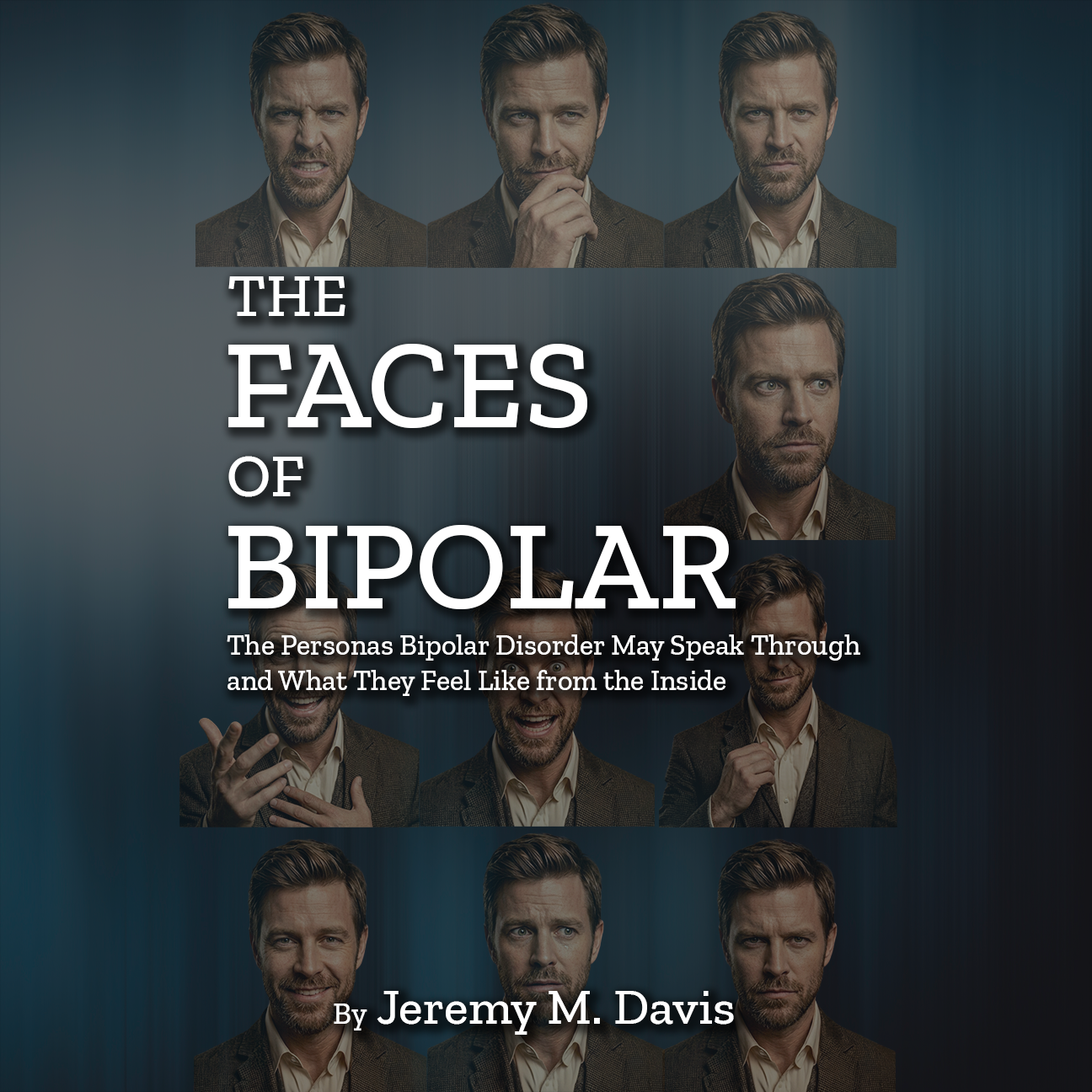
The Faces of Bipolar
The Personas Bipolar Disorder May Speak Through
and What They Feel Like from the Inside.
by Jeremy M. Davis

Relatable Read

Honest, Raw, and Vulnerable
A raw, compelling account of the authors struggle with an illness that has cost him so much. Jeremy writes with the calm, conversational tone of a friend who just wants you to know more about what it’s like inside of his head, and the impact that his illness has on both the everyday as well as the tremendous costs that he has had to face over his life. The book is well written, and very firmly navigates the difference between “This is why I do the things I do” without ever dropping into asking for pity or excuse. The tone and word choice is excellent, and I highly recommend this book to anyone who has BiPolar or who has a friend/loved one with the condition as a means of understanding the tremendous battle being fought every second of every day.
Personal and yet professional, practical, and erudite
One of the very few books offering a ~new take on a health condition that is intellectually responsible, emotionally resonant, and reader-centric. A great book for anyone interested in the idea that bipolar involves multiple persona modes/influences
Review on Goodreads
What stood out to me most was the way the book invites the reader to look beyond the surface and consider what someone may actually be experiencing internally. It offers a perspective that can encourage greater understanding and empathy, especially for readers who may not have much familiarity with bipolar disorder.
I appreciated the personal and thought provoking approach. It’s the kind of book that makes you pause and reflect rather than simply move from one page to the next. I would recommend it to readers interested in gaining a deeper perspective on mental health and the experiences that can exist behind what we see from the outside.
A worthwhile and eye opening read.
An Educational Experience That Won’t Be Forgotten
I was lucky enough to receive an advanced copy of The Faces of Bipolar and can guarantee that any reader looking to gain insight into bipolar disorder will not be disappointed. The author does an excellent job of breaking down clinical bipolar disorder in a way meaningful for both clinical and nonclinical personnel. His description of his own personal experience with the disorder and the personas the disease presents as in himself is moving, thought-provoking, and a page-turner in the best way. I would absolutely recommend this book to any and all looking to learn, understand, and explore bipolar disorder!
This One Is Different
I received an advance copy of this book. I’ve read a lot of bipolar content, and this genuinely landed differently. So much of what’s out there either explains bipolar clinically or simply tells a story. This gives language to what bipolar sounds and feels like from the inside.
The personas you’ve created capture the messy, layered experience of bipolar rather than reducing it to simply mania vs. depression. This is real. This is important.
I can absolutely see people reading this and thinking, ‘Wow! Someone else gets it.’ That’s what makes this book special.
Review on Goodreads
The Faces of Bipolar offers a powerful and thought-provoking perspective on what living with bipolar disorder can feel like from the inside. I appreciated the way the book focuses on the different “personas” and experiences rather than simply presenting the condition in clinical terms. It makes the subject feel personal, human, and easier to understand.
The concept is compelling, and the book encourages empathy for people navigating experiences that others may not always see or understand. It is an insightful and emotionally engaging read that provides a different way of looking at bipolar disorder. Highly recommended for anyone interested in understanding the lived experience behind the diagnosis.
AI Editorial Review: The Faces of Bipolar
August 14, 2026 | Getting review eyes on a new book is very challenging. So many talented authors are creating amazing titles that it’s hard to stand out. Enter the AI era. I gave AI my manuscript and asked for an honest editorial review highlighting particularly compelling, surprising, or unique passages or sections. Here are the results…
Content note: This book contains direct, detailed discussion of suicidal ideation and a suicide attempt. It handles this material responsibly, with crisis resources placed at point of need, but this review reflects that content in the context of craft.
The Faces of Bipolar makes one structural decision that sets it apart from most books in this category, and the whole book’s power flows from it: instead of describing bipolar disorder as a mood that rises and falls, Davis personifies it as a cast of characters who each take the wheel — the Liar, the Critic, the Antagonist, the Sentinel, the Grandiose Champion, the Stimulant, the Frat Boy, the Encourager, the Scared Child, the Murderer. It’s an unusual and genuinely useful conceit, and the book earns it by staying disciplined: each persona gets a full chapter, and each chapter follows the same rigorous shape — what it feels like from inside, what a clinician sees, and what to actually do when it shows up. That repetition isn’t padding; by chapter six or seven it starts to function like a diagnostic tool the reader can use on their own experience.
The book’s most compelling argument is made in Chapter 2, before any of the personas are even introduced. Davis takes the “devil on your shoulder” image everyone already has and shows precisely where it fails: the devil is visibly separate, and you always know it isn’t you. Bipolar’s voice, he argues, speaks in your own syntax, using your real memories and real grievances, which is exactly why it’s so hard to catch. His phrase for this — learning to “hear the italics” around a thought that’s arriving pre- formed rather than being built — is one of the sharper pieces of self-observation in the book, and it reframes everything that follows: the personas aren’t invaders, they’re distortions of material that was already true.
The chapters on the Liar and the Critic are where that argument gets tested against real damage. Davis doesn’t soften what these personas did — messages sent about his wife that “had no business being said or even thought,” a specific accounting of what they cost. What makes the chapters work as more than confession is his insistence that the distortion, not the underlying feeling, is the illness: the fear of being left was real and always had been his; what the Liar did was run that fear “through a machine that produces certainty instead of uncertainty, accusation instead of vulnerability.” That’s a genuinely useful distinction for a reader trying to understand how someone they love could have said something so out of character, and it’s more honest than the easier move of writing the persona off as pure fiction.
Chapter 13, “The Murderer,” is the book’s center of gravity, and it’s the strongest sustained writing in the manuscript. Davis is unusually precise about a detail that’s often smoothed over in this kind of writing: he names the Murderer’s argument as arithmetic, not despair — the claim that his death would be a gift to the people who love him, that he’s “worth more gone than here.” Naming that specific shape of the lie, rather than describing suicidal ideation in general terms, is what makes the chapter land as more than a warning label. It reads like something written by someone who has actually had to argue back against that exact sentence.
The Coda in Chapter 14 is the passage that will stop most readers cold, and it’s worth flagging on its own terms. Davis doesn’t write about the Murderer only in the abstract — he transcribes, persona by persona, the specific case each one made to him on the night of an actual attempt, in something close to real time relative to the book’s completion. The choice to render it as a transcript — the Antagonist’s line, then the Liar’s, then the Encourager’s chillingly calm description of the plan as “orderly” — is a formal risk few writers in this genre take, because it requires showing the reader exactly how convincing the case felt rather than just asserting that it was. The chapter’s turn, from the attempt into the ER into a mental-health facility and back into the resolve that closes it — “I thought I had lost the war. Fortunately, I had only lost the battle” — is the moment the book’s title stops being a metaphor and becomes a report from inside one.
Where the book is most useful for readers who love someone with this diagnosis is in the sections addressed directly to them, scattered through several chapters rather than segregated into one. Davis is careful not to let those passages become a lecture; he tells partners and family plainly that their fear is “appropriate,” that the risk is real, and that supporting someone through this “requires its own attention and its own resources” — permission that caregiver-facing material in this genre often forgets to give.
Chapter 19, “The Letter I Wish I’d Received,” closes the book by doing something structurally smart: it addresses the reader in second person, as the specific person who picked the book up at 3am, rather than a general audience. It’s the right note to end on, because it makes explicit what the persona conceit has been doing all along — giving a name to something that otherwise has no shape, so it can be recognized and answered rather than just endured.
The one place the manuscript could use a firmer editorial hand is pacing: because each of the ten persona chapters follows an identical three-part structure (felt experience / clinical lens / practical action), the middle chapters — the Sentinel, the Grandiose Champion, the Frat Boy — occasionally read as slightly more dutiful than the standout chapters on the Liar, the Critic, and the Murderer, which carry more direct narrative stakes. Trimming the clinical-lens sections in the lower-stakes chapters, or varying the structure slightly chapter to chapter, would keep the book’s considerable momentum from flattening in the back half of Part Two.
Bottom line: This is a book built on a genuinely original piece of psychological architecture — the persona framework — deployed with real discipline and, in the Murderer chapters especially, real courage. It sits closer to An Unquiet Mind than to most contemporary “wellness” writing on bipolar disorder, because it refuses the impulse to resolve into tidy hope; the last chapters are honest that stability is a daily practice rather than an arrival. Readers living with this diagnosis, and the people who love them, are the exact audience this book was built for, and it delivers for both without flattening either one’s experience to serve the other.